
Most coaches trust their eyes and gut instinct to evaluate player performance, yet studies reveal traditional observation misses critical patterns that separate winning teams from losers. Modern sports analytics uncovers hidden performance indicators like high-intensity zone participation and explosive actions that directly correlate with match victories. This guide explains how data-driven methods transform coaching decisions, optimize player development, and deliver measurable competitive advantages across professional and amateur sports.
Table of Contents
- Understanding The Impact Of Analytics On Player Performance
- Decoding Analytics Techniques: PCA, Clustering, And AI In Sports
- Real-World Applications: How Top Teams Leverage Analytics For Competitive Edge
- Advances And Cautions: AI, Computer Vision, And Prediction Model Realism
- Explore Spotifero's Sports Analytics Insights And News
Key takeaways
| Point | Details |
|---|---|
| Analytics reveals hidden patterns | Data identifies performance metrics invisible to traditional observation methods |
| Automated pipelines accelerate insights | Teams reduce manual analysis time by up to 95% with AI-driven data systems |
| AI enhances technique assessment | Computer vision analyzes athlete movements with 94% expert agreement and millimeter precision |
| Realistic model expectations matter | Prediction accuracy above 60% often signals overfitting rather than genuine forecasting skill |
| Data-driven decisions improve outcomes | Evidence-based player management and tactical adjustments increase win probability |
Understanding the impact of analytics on player performance
Sports analytics has fundamentally changed how coaches and analysts understand what drives success on the field. Research demonstrates that winning matches correlate with high-intensity zones and explosive actions, metrics that traditional scouting often undervalues or misses entirely. Players in professional soccer cover an average of 7,132 meters per match, but distance alone tells an incomplete story. The intensity and explosiveness of movement during critical moments determine match outcomes far more reliably than total distance traveled.
Analyzing these specific performance indicators allows coaching staffs to design training programs targeting the physical qualities that actually produce wins. When teams systematically track high-intensity running zones (Z4 and Z5 heart rate zones) and explosive movements like sprints, jumps, and rapid direction changes, they can identify which players excel under competitive pressure and which need targeted development. This data-driven approach removes guesswork from player evaluation and creates objective benchmarks for improvement.
The practical applications extend beyond individual assessment. Comparing activity profiles between winning and losing performances reveals tactical patterns and physical demands specific to your team's playing style. Coaches can adjust substitution timing, rotation schedules, and tactical instructions based on when players typically experience performance drops during matches. This granular understanding of physical output transforms abstract concepts like "work rate" into measurable, trainable qualities.
Key performance metrics coaches should track:
- High-intensity running distance (zones 4-5)
- Number of explosive actions per match
- Sprint frequency and maximum velocity
- Recovery time between high-intensity efforts
- Position-specific movement patterns
Pro Tip: Start with three to five core metrics rather than tracking everything available. Master interpreting those indicators before expanding your analytics dashboard, ensuring your coaching staff actually uses the data rather than drowning in information overload.
Decoding analytics techniques: PCA, clustering, and AI in sports
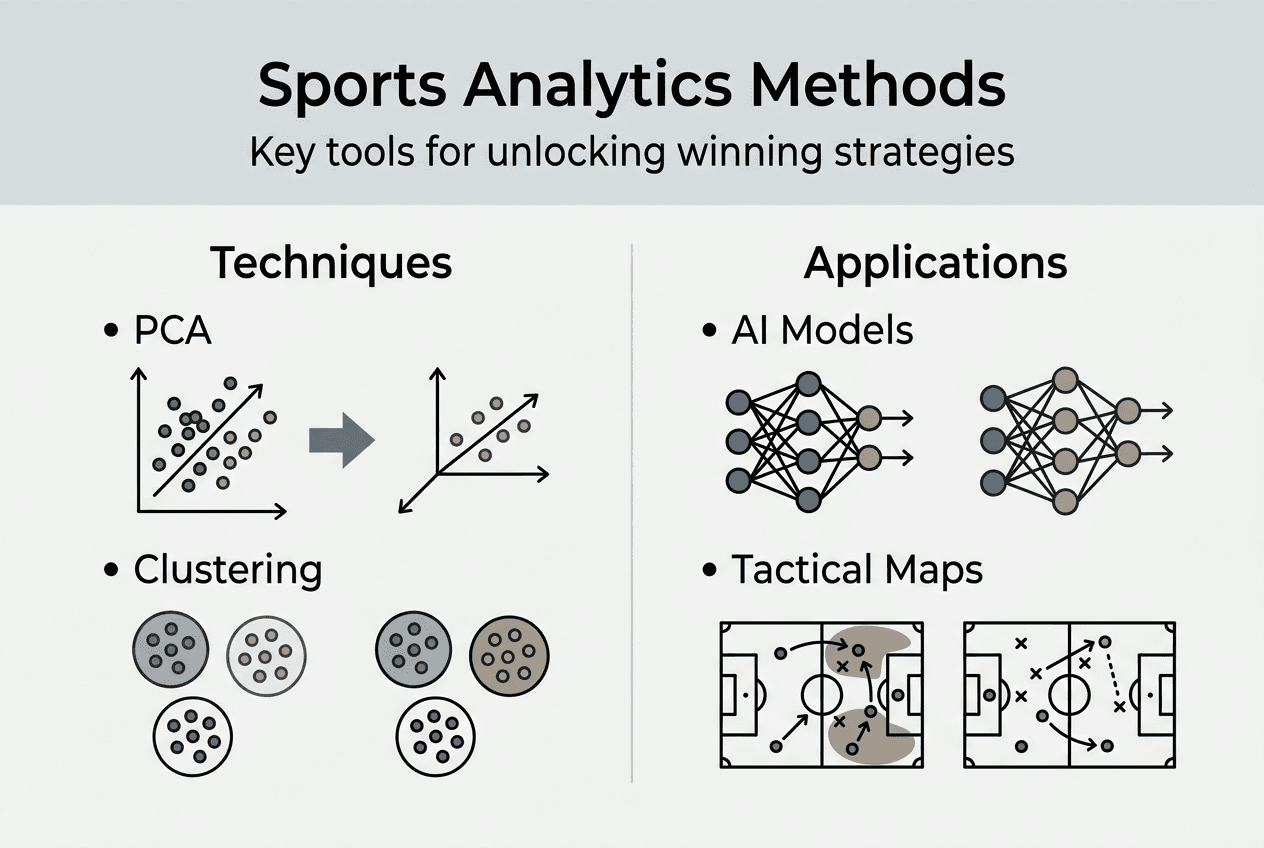
Advanced analytical methods transform raw performance data into strategic intelligence that drives decision making. Principal Component Analysis (PCA) reduces complex datasets containing dozens of variables into a smaller set of meaningful patterns while preserving the information that matters most. In sports contexts, PCA explains 68% of total variance across multiple performance dimensions, allowing analysts to identify which combinations of metrics truly differentiate elite from average performance.
Clustering algorithms take this analysis further by grouping similar performances or players together based on their statistical profiles. Research has identified three distinct match profiles through clustering: balanced games with moderate intensity, high-intensity battles with elevated physical demands, and low-engagement contests with reduced activity levels. Understanding which profile characterizes an upcoming opponent allows coaches to prepare players physically and tactically for the specific demands they will face. This contextual awareness prevents generic preparation approaches that fail to address match-specific challenges.
Artificial intelligence pipelines have revolutionized how teams process and interpret performance data at scale. AI-driven systems segment players into distinct roles and efficiency categories, revealing batting efficiency patterns and power hitting profiles that inform roster construction and lineup optimization. These automated systems identify performance baselines for each player segment, making it easy to spot when individuals underperform relative to their peer group and require intervention.

The power of combining these methods becomes apparent when addressing specific performance challenges. If your team struggles with strikeout rates, AI clustering can identify which batters share similar swing patterns and pitch recognition weaknesses. PCA then reveals which combination of factors (swing speed, launch angle, pitch selection) most strongly predicts strikeout risk. This multi-layered analysis produces targeted training interventions rather than generic batting practice.
Analytical methods and their applications:
| Method | Primary Use | Key Benefit |
|---|---|---|
| Principal Component Analysis | Reduce data complexity | Identifies critical performance drivers |
| Clustering algorithms | Group similar profiles | Reveals tactical contexts and player types |
| AI classification | Automate pattern recognition | Scales analysis across entire rosters |
| Regression modeling | Predict outcomes | Quantifies impact of specific variables |
Pro Tip: Validate your analytical models against out-of-sample data before making major decisions. A model that perfectly explains past performance but fails on new data has simply memorized history rather than learned genuine patterns.
Real-world applications: how top teams leverage analytics for competitive edge
Professional sports organizations have moved beyond experimental analytics adoption to full-scale integration of data-driven decision making. The Philadelphia Union soccer club exemplifies this transformation, having reduced insight generation time by 95% through automated data pipelines. This efficiency gain saves approximately 60 hours weekly that analysts previously spent on manual data processing, freeing them to focus on strategic interpretation and coaching collaboration. The speed advantage allows the team to adjust tactics between matches based on fresh opponent analysis rather than outdated scouting reports.
NBA franchises have similarly embraced analytics infrastructure that transforms how coaches access and utilize performance data. One organization partnered with technology providers to reimagine how performance metrics flow from collection to coaching application. The resulting system delivers real-time insights during practices and games, enabling immediate adjustments rather than post-game reviews. This temporal advantage turns data into a competitive weapon rather than a historical record.
The common thread across successful analytics implementations is the focus on actionable insights rather than data collection for its own sake. Teams that thrive with analytics have established clear workflows connecting data analysis to coaching decisions, player development programs, and roster management. They invest in training coaching staffs to interpret analytics outputs and integrate findings into their existing expertise rather than replacing human judgment with algorithms.
Steps for implementing analytics in your organization:
- Identify specific decisions that data could improve (lineup selection, training load management, opponent preparation)
- Establish automated data collection processes to eliminate manual entry bottlenecks
- Create simple dashboards focusing on actionable metrics rather than comprehensive data dumps
- Train coaches and staff on interpreting analytics within their domain expertise
- Build feedback loops where coaching insights improve analytical models over time
- Measure analytics impact on actual outcomes like wins, injuries prevented, or player development speed
Collaboration between analytics teams and coaching staffs determines whether data drives improvement or gathers dust in unused reports. The most effective organizations treat analytics as a shared language that enhances communication between different expertise areas rather than creating siloed departments. When analysts understand coaching priorities and coaches grasp analytical capabilities, the combination produces insights neither group could generate independently.
"The goal is not to replace coaching intuition with algorithms, but to enhance decision making by combining domain expertise with empirical evidence. The best organizations achieve this synthesis rather than treating analytics and coaching as competing philosophies."
Pro Tip: Start analytics initiatives by solving one specific problem your coaches already care about. Early wins build credibility and enthusiasm for expanding analytics applications across other areas.
Advances and cautions: AI, computer vision, and prediction model realism
Cutting-edge artificial intelligence applications in sports extend beyond traditional statistical analysis into visual assessment of technique and movement quality. Deep learning models using convolutional neural networks now analyze athlete biomechanics from standard broadcast footage, eliminating the need for expensive marker-based motion capture systems. Research shows computer vision achieves 94% agreement with expert human evaluators and maintains accuracy within 15 millimeters when tracking joint positions and movement patterns. This precision enables coaches to assess technique at scale across entire rosters rather than limiting detailed analysis to a few key athletes.
Computer vision systems track players and objects throughout matches, generating spatial data that reveals tactical patterns invisible during live viewing. These systems automatically identify formations, pressing triggers, passing networks, and space creation without manual coding. The automation allows analysts to process entire seasons of footage in the time previously required for a single match, uncovering patterns that only emerge across large sample sizes. Teams gain insights into opponent tendencies and their own tactical execution that would be impossible to detect through traditional film study.
Despite these technological advances, sports analytics faces significant challenges around prediction accuracy and model reliability. Many publicized prediction models claiming accuracy rates above 60% suffer from fundamental flaws like overfitting to historical data or information leakage where future information contaminates training data. Analysis of sports prediction pitfalls demonstrates that even sophisticated NFL prediction models with impressive backtest results lose money when applied to actual betting markets. Professional sports bettors typically achieve 55% to 58% accuracy over sustained periods, making claims of 70% or 80% accuracy strong indicators of methodological problems rather than genuine forecasting skill.
The gap between backtest performance and real-world results stems from several sources. Historical data contains patterns that seem predictive but actually reflect random variation or circumstances that no longer apply. Models trained on complete season data inadvertently use information that would not have been available at prediction time, creating artificially inflated accuracy. The dynamic nature of sports means that today's patterns may not persist into tomorrow's games as teams adapt and circumstances change.
Comparison of analytics technologies:
| Technology | Accuracy Level | Primary Application | Key Limitation |
|---|---|---|---|
| Computer vision | 94% expert agreement | Technique assessment and tracking | Requires quality video footage |
| Traditional stats models | 55-58% sustained accuracy | Game outcome prediction | Limited by sport randomness |
| AI player classification | 85-90% category accuracy | Role identification and profiling | Needs large training datasets |
| Wearable sensors | Near 100% measurement accuracy | Physical load monitoring | Does not capture tactical context |
Understanding these limitations prevents organizations from making costly decisions based on overconfident predictions. Analytics should inform judgment rather than replace it, providing probabilistic insights that coaches integrate with their tactical knowledge and situational awareness. The most sophisticated teams use prediction models to identify edges and opportunities while maintaining realistic expectations about the inherent uncertainty in sports outcomes.
Pro Tip: Require any prediction model to demonstrate out-of-sample accuracy on truly future events before trusting its forecasts. Backtest results alone provide insufficient evidence of genuine predictive power.
Explore Spotifero's sports analytics insights and news
Staying current with evolving analytics methods and applications requires access to comprehensive, expert-curated resources that track developments across multiple sports and analytical approaches. Spotifero delivers up-to-date sports analytics news and analysis covering the latest tools, case studies, and research findings shaping how teams leverage data for competitive advantage. The platform aggregates insights from professional leagues, academic research, and technology providers, giving you a centralized source for understanding analytics trends.
Whether you need updates on AI applications in player evaluation, computer vision advances in technique assessment, or case studies showing how top organizations implement analytics infrastructure, Spotifero provides the depth and breadth to support your learning. Resources are available in multiple languages, including comprehensive sports analytics coverage in Polish, ensuring global accessibility for analysts, coaches, and athletes pursuing data-driven performance improvement. The platform's organization by topic and sport makes it easy to find relevant content for your specific analytical interests and challenges.
FAQ
What role does high-intensity activity play in winning games?
High-intensity running and explosive actions show strong correlations with match victories across multiple sports, particularly soccer and basketball. Teams that maintain higher participation in heart rate zones 4 and 5 during critical match moments typically outperform opponents who cannot sustain that intensity. Tracking these metrics allows coaches to identify which players deliver peak performance under competitive pressure and design training programs that build the physical capacity to execute tactics at game speed.
How do AI and computer vision enhance sports analysis?
Artificial intelligence systems classify player techniques and tactical patterns with over 90% accuracy compared to expert human evaluators, scaling analysis across entire rosters and seasons. Computer vision tracks athlete movements and object trajectories from broadcast footage with millimeter-level precision, generating spatial data that reveals tactical patterns invisible during live viewing. These technologies automate labor-intensive analysis tasks, freeing analysts to focus on strategic interpretation and coaching collaboration rather than manual data collection.
Why should we be cautious about sports prediction models?
Prediction models with backtest accuracy above 60% often suffer from overfitting or data leakage, where the model has memorized historical patterns rather than learned genuine forecasting relationships. Professional sports bettors typically achieve 55% to 58% accuracy over sustained periods, making dramatically higher claims warrant skepticism about methodology. Real-world application frequently reveals that impressive backtest results do not translate to actual predictive power when facing truly future events the model has never seen.
What metrics should coaches prioritize when starting with analytics?
Begin with three to five performance indicators directly connected to your sport's winning factors, such as high-intensity running distance, explosive action frequency, or position-specific efficiency metrics. Master collecting and interpreting these core metrics before expanding to comprehensive tracking, ensuring your coaching staff actually uses insights rather than drowning in unused data. Focus on metrics you can influence through training and tactical decisions rather than tracking statistics beyond your control.
How can smaller organizations compete with well-funded analytics programs?
Focus analytics efforts on specific high-impact decisions where data provides clear advantages, such as opponent preparation or training load management, rather than attempting to match larger organizations across all areas. Many powerful analytical tools and methods are now accessible through affordable software platforms and open-source resources, democratizing capabilities previously limited to elite programs. Building strong collaboration between coaches and analysts often matters more than budget size, as organizations that effectively translate data into decisions outperform those with sophisticated systems but poor implementation.